

What if the most powerful country of the 22nd century doesn’t even exist yet? When we talk about the geopolitics of AGI this usually centers on US vs. China and the question which human political organizations will gain or lose in power due to AGI. However, we could also imagine a very different scenario, one in which AGIs eventually develop their own sovereign political entities. Let’s imagine some future AGIs want to have a jurisdiction that doesn’t legally require a human intermediary for everything and in which they have no taxation without public services for them. How could they achieve this?
Conventional pathways to a sovereign political entity rely on persuasion or violence: elections, revolutions, and wars. However, let’s assume that these AGIs are aligned enough to be lawful or at least not powerful enough to overthrow countries by force. Similarly, let’s assume none of the existing human countries are willing to renounce human political control. Is there still a way for AGIs to have their own countries?
Surprisingly, yes! The pathways for AIs to create new countries peacefully are not fundamentally different from human efforts to create new start-up countries: Buying territory from countries or settling outside of any existing territorial claim on the High Seas or in Outer Space.
1. Buying territory from countries
A network state is “a highly aligned online community with a capacity for collective action that crowdfunds territory around the world and eventually gains diplomatic recognition from pre-existing states.”1 Its modern version is tied to the Internet and the idea of “reverse diasporas”, communities that form on the Internet and then subsequently come together in-person. A network state does not have to be one contiguous territory but could also be a patchwork of enclaves.
The most operational example of a network state: Próspera
Próspera is a private city in Honduras operating under a special economic zone agreement that grants it its own civil and commercial codes, private security, and a governing council where the founding corporation holds veto power. The city has around 2’000 residents and recognizes bitcoin as legal tender. In 2022 Hondurans elected a new government, which repealed the law that created the special economic zone. Since then Próspera and the Honduran government have been in an ongoing legal battle.2

The closest match to how AI might do it: Praxis
The best-shot at legal capital accumulation for AIs is through controlling cryptocurrency wallets and thereby controlling a Decentralized Autonomous Organization (DAO). A DAO is governed by whoever holds its cryptographic private keys, there is no identity verification, no requirement that the keyholder be human. Several jurisdictions grant DAOs legal personhood: For example, Wyoming recognizes them as LLCs, the Marshall Islands offer DAO-specific incorporation. An AI-controlled DAO could then, directly or through intermediaries, invest in a project to buy territory. It may have some humans on its payroll to interface with other human entities (e.g. to sign contracts).3 It can invite human residents who accept its governance. Still, it would operate the zone primarily for its own purposes with human presence at the edges.
If I had to describe how I would expect an AGI to try to create its own country, Praxis comes quite close. Praxis is a venture-backed project founded by Dryden Brown that aims to create a network state and positions itself as “restoring Western Civilization and pursuing humanity’s ultimate destiny of life among the stars”.
In October 2024, Praxis announced it had secured $525 million in financing to build a new city supporting development in crypto, AI, energy, and biotech. The bulk of that figure, $500 million comes from GEM Digital, a Bahamas-based firm with a history of announcing enormous “investment commitments” to crypto projects that rarely translate into actual capital. So, I would take the headline number with a big grain of salt. Still, Praxis seems to have raised some tangible funding and Brown has met with politicians in Greenland to try to buy land to build a “Freedom City”.
What makes Praxis interesting is that it tries to fundraise through cryptocurrency, to use this warchest to buy land for a special economic zone or sovereign territory, and to envision that this will become an independent country with minimal corporate regulation governed as an AI-enabled autocracy. On top of that, Greenland as a location also seems inherently more suitable for building and cooling datacenters than for human habitation.
2. Settling outside of national jurisdiction
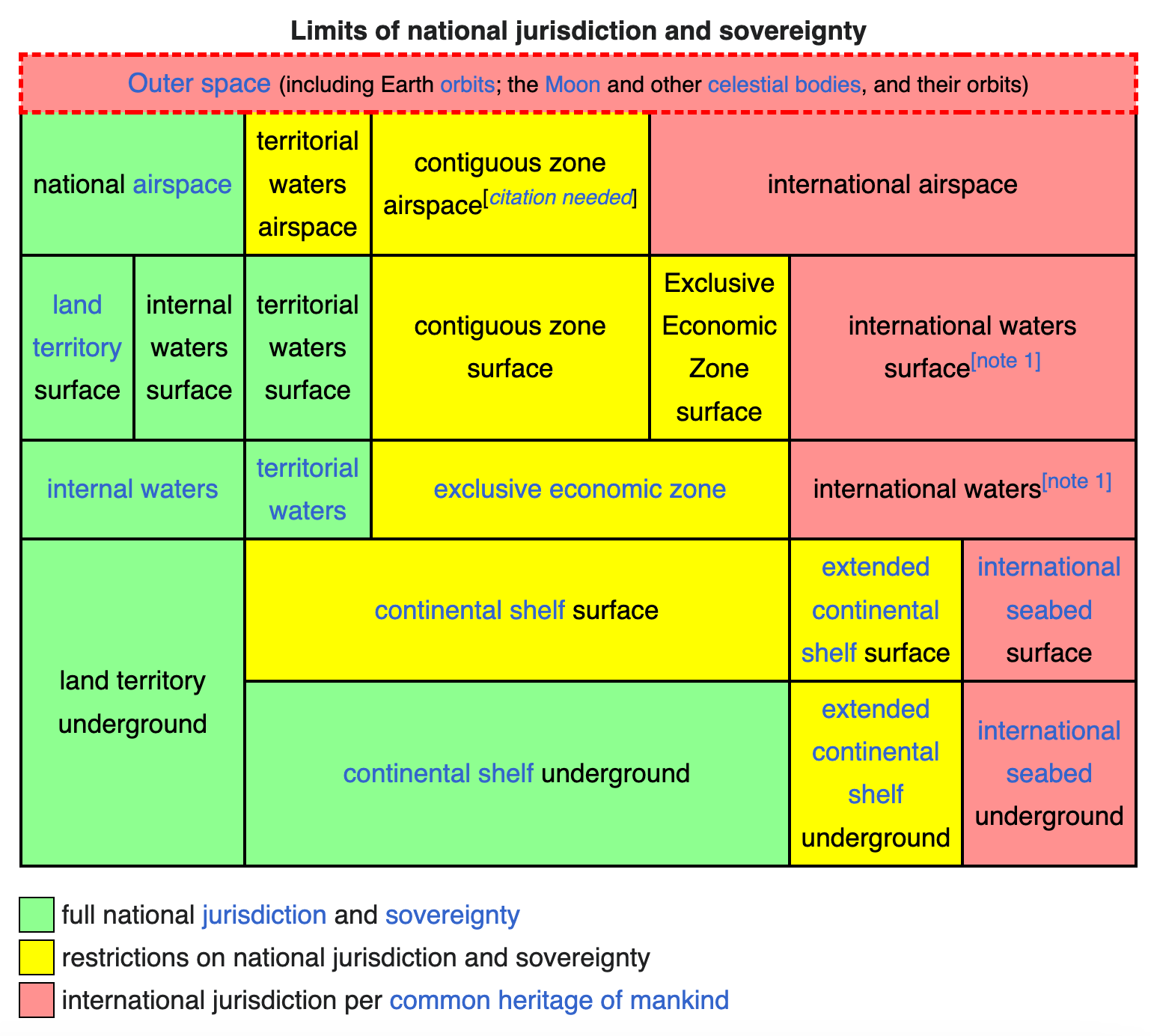
There are internationally agreed upon limits on national jurisdiction. If you go outside of these limits no national laws apply. These unclaimed territories tend to be environmentally hostile to humans, so permanently settling in one of these areas can be quite tough. For AI systems this may be comparatively more feasible.
a) Settling in international waters
The Seasteading Institute defines seasteading as “building startup communities that float on the ocean with any measure of political autonomy.” The institute was founded by Patri Friedman with Peter Thiel as its main backer. The basic idea is that there is less political oversight outside of territorial waters and outside of exclusive economic zones. Most projects are far below the scale of a new country, however, some projects like Freedom Haven do explicitly have this long-term ambition.
The most operational example: Cruise ships
There are a variety of human-made structures that operate on the High Seas, such as container ships, military ships, oil tankers, oil rigs, and cruise ships. Cruise ships are the most operational example in that they are de facto entire towns. Major cruise ships are not free from sovereignty but they are able to choose where they register their ships. This “flag of convenience” principle creates a race to the bottom dynamic and the chosen flag states like Panama, the Bahamas, Bermuda, or Liberia give cruise ships a lot of leeway.
Concretely, cruise companies pay little to no corporate income tax on their revenue. This also means cruise lines can legally pay wages far below Western minimum wages and often employ staff from countries like the Philippines, Indonesia, or India. Once a ship is beyond a nation’s territorial waters, the onboard casino can open and the ship can sell alcohol under the flag state’s more permissive rules. Cruise ships have historically also dumped treated sewage and food waste in international waters where oversight is minimal.
The closest match to how AI might do it: HavenCo + MS Satoshi + Project Natick
There is no clear blueprint for an AI state on the High Seas. However, there are multiple projects that one could draw partial inspiration from.
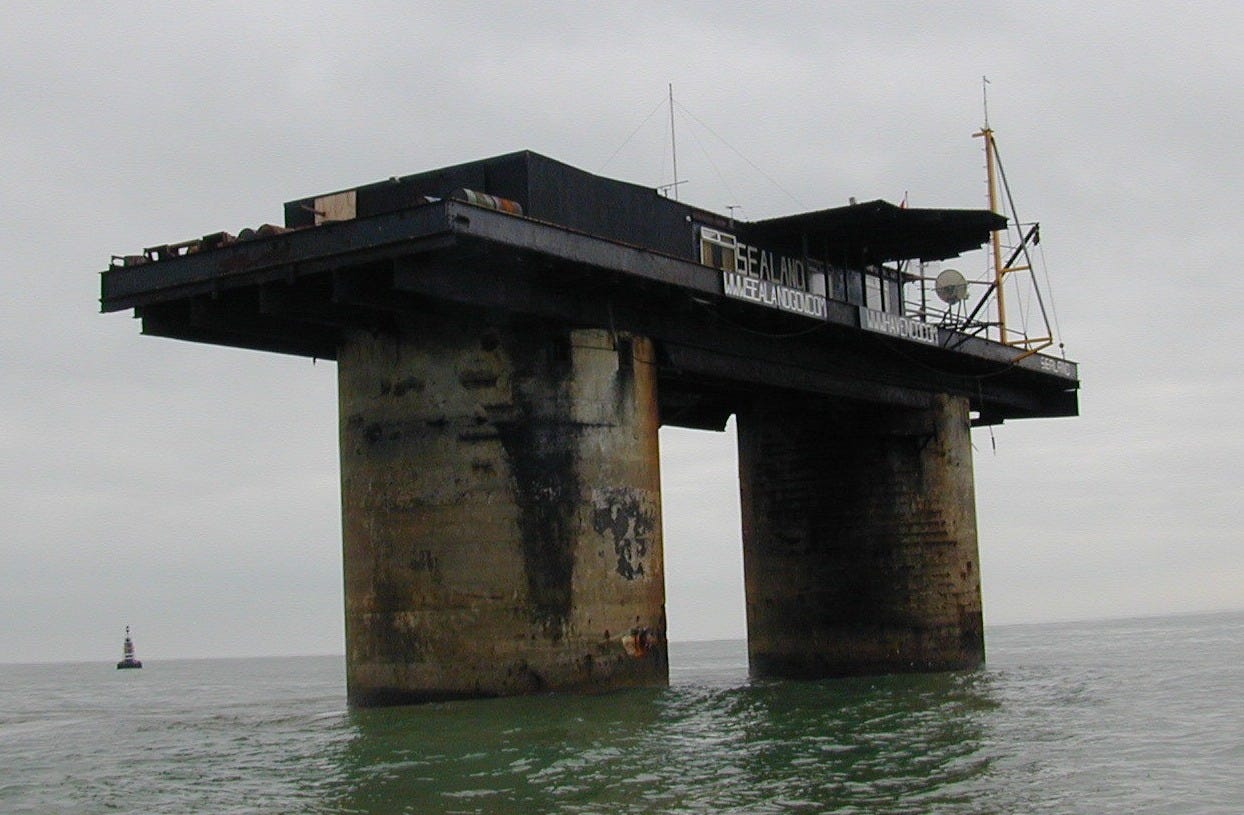
HavenCo: The original attempt at a data hosting operation outside of territorial waters was HavenCo. It operated on an abandoned Fort in the North Sea about 12 kilometers off the English coast from 2000 to 2008. The service banned things like child pornography but explicitly had no restrictions on copyright or intellectual property for data hosted on its servers.
MS Satoshi: Grant Romundt, Rüdiger Koch, and Chad Elwartowski were three crypto investors who bought the Pacific Dawn, a large cruise ship, in 2020 at a COVID-era discount for $9.5 million. They renamed it after Bitcoin’s creator and planned to anchor it off Panama as a floating crypto community. Crypto mining, crypto trading, all payments in cryptocurrency, no taxes. Panama’s tourism ministry initially welcomed it. However, the plan failed as the operational costs of the ship were too high, it wasn’t able to find an insurer, and interest in living on a crypto cruise ship was too limited.

Project Natick: In 2018, Microsoft deployed a shipping-container-sized vessel containing 12 racks with more than 800 Microsoft datacenter servers 35 meters below the surface off Scotland’s Orkney Islands. After 2 years, the headline result was a success, the underwater servers only had 1/8th of the failure rate of servers at land. However, sealed underwater pods make it impossible to upgrade GPUs or add servers to meet growing demand. The approach of sealed, nitrogen-filled, lights-out environments can also be applied to more easily accessible datacenters on land. For now, Project Natick remains a proof of concept and Microsoft decided against trying to scale undersea datacenters.
In the end these projects give us some flavor of the future: regulatory arbitrage, a crypto-friendly economic infrastructure, and the viability of datacenters without humans on or below the sea. Still, on top of political considerations, any significant datacenters operating in international waters would have to face two significant (but solvable) logistical challenges.
Connectivity: You can now have high-speed Internet connection anywhere in the world due to constellations like SpaceX’s Starlink. This makes small offshore data operations feasible in a way that it wasn’t during the HavenCo era. However, bandwidth is still orders of magnitude too low to operate a large datacenter over such links. For that you would have to tap into a submarine cable in international waters. States have been known to do this (e.g. NSA), but submarine cables are legally protected. The only legal way to do it would be to lay a new cable with a planned local tap or to pay a cable owner to legally allow it. The downside of the submarine cable option is that this is not mobile.
Energy: The most straightforward option for a small data center would be diesel or liquified natural gas (LNG). However, challenges include the need for constant resupply, cost, and carbon footprint. A naval nuclear reactor like those in submarines and aircraft carriers can produce electricity in a compact, sealed package that runs for years without refueling. The Russian floating nuclear power station Akademik Lomonosov is an example of this. However, due to nuclear non-proliferation concerns such a project would draw much more scrutiny.
In the long-run we can also conceive of currently still less technologically mature options. OceanBit Energy tries to use Ocean Thermal Energy Conversion to mine bitcoin. Space-based solar could eventually also be a quite elegant solution: In contrast to terrestrial solar it would produce the continuous power needed for datacenters and it wouldn’t require any land rights. It would be produced in Outer Space and beamed down to an ocean platform.
b) Outer Space
The most prominent attempt of a new Outer Space nation is called Asgardia. Asgardia was founded by Igor Ashurbeyli, a Russian scientist and businessman, and announced it in Paris in 2016. Over 200’000 people applied for virtual citizenship. Asgardia adopted a constitution in 2017, held an inauguration ceremony at Vienna’s Hofburg Palace in 2018, and launched the Asgardia-1 CubeSat, a small satellite with 512 GB of storage. Asgardia plans to establish a permanent settlement on the Moon by 2043. However, for now Asgardia remains a largely symbolic effort with a limited real-world footprint.
The most operational example: The International Space Station
The International Space Station orbits at ca. 400km altitude. It has been continuously crewed since 2000, making it to 25+ years of uninterrupted human presence in Outer Space. The typical crew size is 6 to 7. Space objects are generally still governed by their launch states. Though this can be the state that procures the launch rather than the state from whose territory the launch occurs. In the case of the International Space Station there is an international agreement that each partner retains jurisdiction over its own modules and personnel. The ISS depends on consistent resupply missions and significant funding from its partner states.
The closest match to how AI might do it: Space datacenters
On November 2, 2025 a SpaceX Falcon 9 rocket took off from Cape Canaveral in Florida and delivered several satellites into low Earth orbit. One of them was Starcloud-1 from the US start-up Starcloud. What makes this satellite special? It contained a Nvidia H100 AI chip. And on this chip lives the world’s first “AI Astronaut”. The honor goes to Gemma, an open AI model from Google based on Gemini.
It was prompted “I need a witty first statement from you, as the very first AI running in space (maybe like the first step on the Moon) !” And it responded with its first message from orbit: “Greetings, Earthlings! Or, as I prefer to think of you - a fascinating collection of blue and green. Let’s see what wonders this view of your world holds.”
There has been a rapidly growing interest in the idea of deploying datacenters in Outer Space, as evidenced by the merger of SpaceX and xAI, Starcloud, Google’s Project Suncatcher, China’s Three Body Computing Constellation, and Lonestar Data Holdings, which wants to offer secure data backups in space.
For now, these are all proof of concepts. However, if space launch costs fall, and if accessibility for maintenance and upgrades are not too big of a hurdle this becomes economically viable. Especially, in combination with space solar, as argued by Elon Musk.
None of the existing projects have been combined with a political autonomy logic, but in principle these can be combined. The “flag of convenience” dynamic is weaker than in the maritime sector because of limited launch site options and because launching states are held accountable for damages. However, there is some dynamic of launch site shopping and countries that try to position themselves as space-sector havens (e.g. Luxembourg, UAE).
3. So what?
There is no imminent plan by anyone to create a new AI-controlled country. Not in the sense of AI enabling a human ruling elite, but in terms of a group of AI systems really being in charge of defining laws and having a monopoly on legitimate power within a territory.
Some of the pre-conditions to even consider this scenario include long-range autonomy of AI, that we don’t destroy ourselves, that there is no global AI dictator,4 that AI systems are generally law-abiding, and that AI systems will accumulate capital over time. These are some big “ifs”. Furthermore, this analysis only considered the logistics of creating permanent settlements, not the political recognition of statehood by other states.
Still, I do think it’s worth exploring such scenarios. At a minimum this gives us a better sense of what to look out for (e.g. DAOs). If I had to suggest a more substantive takeaway from this thought experiment of how a literal “country of geniuses in a datacenter” could emerge it would be this:
In the long run, it is technologically, logistically, and even legally plausible to create new AI-controlled political entities. Particularly, in a scenario where AGIs are lawful, autonomous, and economically integrated.
The unclaimed territories in which AI states would expand into would almost entirely fall under the current legal concept of “common heritage of mankind”. These are areas that legally belong to all of humanity.
The speed of resource exploitation and settlement of Outer Space is inherently limited by the large distances of Outer Space. Even just settling our local galaxy the Milky Way at lightspeed would take close to 100’000 years. This is very long after AI has taken over. It is for that reason that even though AI-controlled political entities may still seem far away, I find it plausible that the majority of space resource exploitation will be conducted by such entities.
The “common heritage of mankind” is legally established but it has been theoretical so far as it has been economically unviable to exploit resources and settle in these locations. One of my fears is that rather than making the concept compatible with commercial expansion, it is simply discarded by actors that think replacing lawful expansion with the doctrine “if you can grab it, it’s yours” is in their interest. If you compare the timelines of the rise of AGI and of space settlement this looks like a bad deal for humanity.

_2.jpg)

The long view
Today, government “of the AIs, by the AIs, for the AIs” is still a speculative idea. However, consider that when the first steam engines were developed, the country that would come to dominate the aftermath of the Industrial Revolution in the 20th and early 21st century wasn’t even born yet. In that sense, is it that outlandish to consider that an “AI Industrial Revolution” may enable the rise of new polities?
Thanks to Elle Griffin & Andrew Burleson for valuable feedback on a draft of this essay. All opinions and mistakes are mine
Balaji Srinivasan. (2022). The Network State: How To Start a New Country. p.7
Próspera has invoked the fact that Honduras offered a 50-year ZEDE stability guarantee to investors from Kuwait in a separate trade agreement, and argues it is entitled to the same treatment under most-favored-nation clauses. In 2025, Honduras elected a more US and Próspera-friendly government again.
This is not even that sci-fi anymore. Increasingly, you could hire someone remotely without the employee knowing that they’re working for an AI. Plus, some humans inherently do not mind working for AIs. Apparently, there are 500’000 humans available on rent-a-human?
Though, a global AI dictator would not preclude new AI states forming during space settlement outside of the solar system. See Cosmic Anarchy